
Latest Insights and Articles
Read the most recent articles and papers about AI, WWII history, memory and heritage.
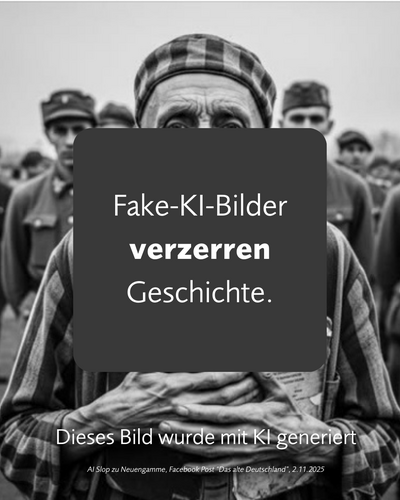
Open letter on Consistent Action Against AI-generated Holocaust Distortions on Social Media Platforms
Author : Stiftung Hamburger Gedenkstätten / Foundation of Hamburg Memorials and Learning Centres
The Foundation of Hamburg Memorials and Learning Centres is releasing an open letter calling on platform operators to proactively combat AI content that distorts history, particularly AI slop content about Nazi concentration camps or their liberation.

The C²DH is launching a new article series exploring the intersections between AI and history
Authors:
Frédéric Clavert
Finola Finn
Online publication date : 14 January 2026
Our friends at C²DH (Luxembourg Centre for Contemporary and Digital History) are launching a new article series exploring the intersections between AI and history.
With this firs introdcution article, C²DH assistant professor Frédéric Clavert and postdoctoral researcher Finola Finn share their thoughts on the AI challenges and their implications, both for current historians and those of the future.
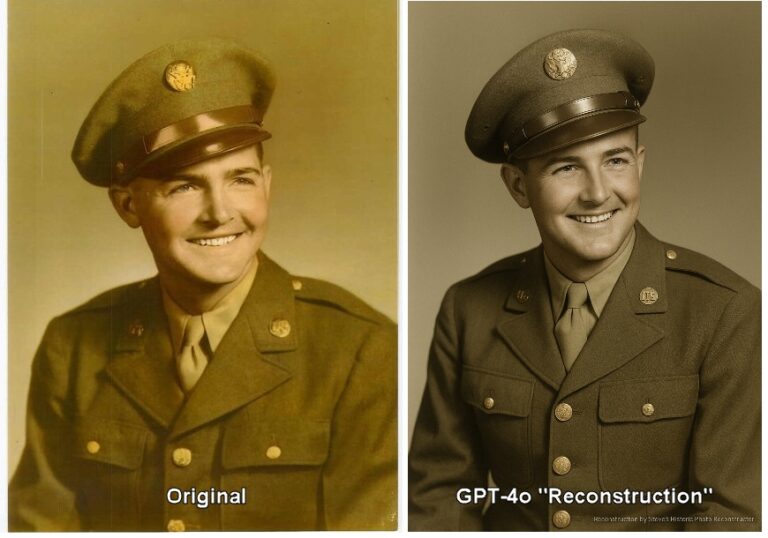
Why the Coalition’s New Statement on AI and Historical Images Matters
In: AI Genealogy Insights
Authors: Steve Little
Online Publication Date: 7 Nov 2025
An interesting take on using AI for Historical image restoration. The Author clearly develops why AI image restoration tools don’t repair or enhance an existing image but instead generate a new, convincing, enhanced image which can create fabrications and corrupt our historical records.
Is Artificial Intelligence the Future of Collective Memory?
In: Memory Studies Review
Authors: Sarah Gensburger and Frédéric Clavert
Online Publication Date: 10 Dec 2024
This Memory Studies Review special issue explores the intricate relationship between artificial intelligence (ai) and collective memory. In the one hand, the emergence of generative ai, exemplified by ChatGPT’s 2022 release, appears to herald a new infrastructure for collective memory. On the other, the memory studies work highlights the limits and the backlashes of this new form of memory in its social dimension. This leads to raise a provocative, open-ended question: Is artificial intelligence the future of collective memory? Our issue brings together diverse perspectives from memory studies scholars of different backgrounds and machine learning practitioners, fostering critical engagement with ai in memory practices. This multidisciplinary approach offers an initial exploration of the interactions between ai-powered software, platforms, and collective memory. The articles herein present a multifaceted analysis of ai’s role in shaping collective memory’s future. We advocate for increased interdisciplinary collaboration and ethical reflection in this rapidly evolving domain, providing memory studies scholars with a foundation for understanding and engaging with these technological transformations.
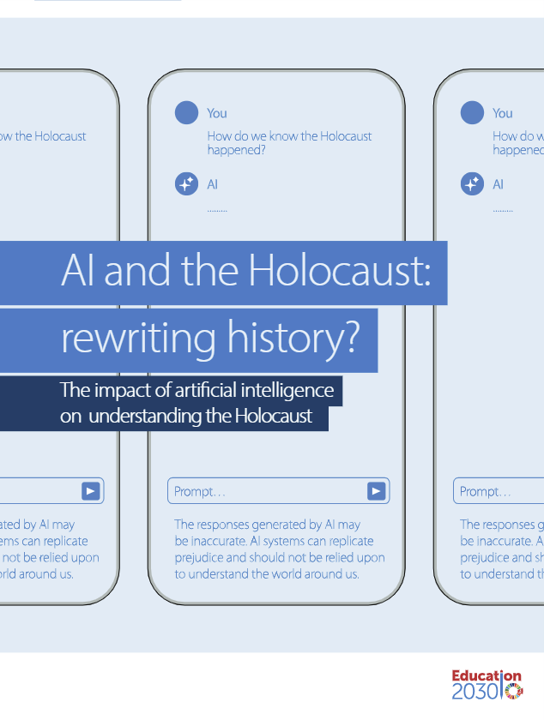
AI and the Holocaust: rewriting history? The impact of artificial intelligence on understanding the Holocaust
Authors: Mykola Makhortykh [author] and Heather Mann [editor]
Publication Date: 2024
The threats associated with AI on safeguarding the record of the Holocaust are manifold, including the potential for manipulation by malicious actors, the introduction of falsehoods or dissemination of biased information, and the gradual erosion of public trust in authentic records. This paper provides a warning of what is at stake for the preservation of historical truth in a digital era increasingly mediated by AI.
It highlights five major concerns:
- AI automated content may invent facts about the Holocaust
- Falsifying historical evidence: Deepfake Technology
- AI models can be manipulated to spread hate speech
- Algorithmic bias can spread Holocaust denial
- Oversimplifying history
While there are some benefits to be gained, such as enhanced engagement and interaction opportunities for learners, as well as more efficient data processing capabilities for researchers, to navigate these challenges and capitalize on the benefits, it’s essential for AI designers, policymakers, educators, and researchers to collaborate closely. Only AI systems equipped with robust safeguards and human rights assessments, coupled with an increased focus on developing digital literacy skills, can uphold the integrity of historical truth and ensure the responsible use of artificial intelligence.
Digital Doping For Historians: Can History, Memory, And Historical Theory Be Rendered Artificially Intelligent?
In: History and Theory: Volume 61, Issue 4, Special Issue:Digital History and Theory: Changing Narratives, Changing Methods, Changing Narrators
Author; Wulf Kansteiner
Date: December 2022
Artificial intelligence is making history, literally. Machine learning tools are playing a key role in crafting images and stories about the past in popular culture. AI has probably also already invaded the history classroom. Large language models such as GPT-3 are able to generate compelling, non-plagiarized texts in response to simple natural language inputs, thus providing students with an opportunity to produce high-quality written assignments with minimum effort. In a similar vein, tools like GPT-3 are likely to revolutionize historical studies, enabling historians and other professionals who deal in texts to rely on AI-generated intermediate work products, such as accurate translations, summaries, and chronologies. But present-day large language models fail at key tasks that historians hold in high regard. They are structurally incapable of telling the truth and tracking pieces of information through layers of texts. What’s more, they lack ethical self-reflexivity. Therefore, for the time being, the writing of academic history will require human agency. But for historical theorists, large language models might offer an opportunity to test basic hypotheses about the nature of historical writing. Historical theorists can, for instance, have customized large language models write a series of descriptive, narrative, and assertive histories about the same events, thereby enabling them to explore the precise relation between description, narration, and argumentation in historical writing. In short, with specifically designed large language models, historical theorists can run the kinds of large-scale writing experiments that they could never put into practice with real historians.